Wondering why Monterey homes can feel so different from one block to the next? In a city shaped by early California history, postwar growth, and a cool marine climate, the answer usually comes down to style, setting, and how a home handles coastal living. If you are trying to buy or sell in Monterey, this guide will help you understand the home styles buyers notice most, what they tend to feel like day to day, and what practical tradeoffs matter before you make a move. Let’s dive in.
Why Monterey Home Styles Matter
Monterey is not a one-style market. Local planning documents show a broad architectural timeline that includes Monterey Colonial, Spanish Colonial, Colonial Revival, Craftsman Bungalow, Mission Revival, Queen Anne, Shingle Style, and later housing layers that include multi-family and newer infill.
That variety matters because Monterey is also an expensive market with a mix of historic homes, rentals, and attached housing all in the same city. Census data shows a median owner-occupied home value of $1,076,300, a median gross rent of $2,353, and an owner-occupied housing unit rate of 36.2% in 2020 to 2024 data.
For you as a buyer or seller, that means style is not just about looks. It often affects layout, maintenance, renovation options, and how a home lives in Monterey’s fog, wind, and salt air.
Monterey Colonial Homes
Monterey Colonial is the city’s signature historic style. The Larkin House is widely recognized as the prototype, and the style blends New England and Southwestern building methods.
These homes often include thick adobe walls, a two-story form, minimal ornament, a hipped roof, wood windows, stone foundations, and a long covered upper porch or veranda. That porch was not just decorative. It also helped protect adobe walls from water exposure.
In daily life, Monterey Colonial homes often feel more vertical than modern single-level layouts. You may notice more defined rooms, interior stairs, and a stronger connection between indoor spaces and covered outdoor areas.
If you are drawn to history, architecture, and a strong sense of place, this style can be especially compelling. The appeal is often tied less to open-concept living and more to sheltered outdoor space, views, and Monterey’s early California identity.
Craftsman Bungalows And Cottages
Craftsman homes and modest vernacular cottages are another important part of Monterey’s housing story. Historic surveys in Lower Old Town describe simple rectangular forms, gabled porch roofs, exposed rafter tails, knee braces, and other Craftsman-era details.
The city’s guidelines describe Craftsman Bungalows as one to one-and-a-half stories with low-pitched roofs, wood sash windows, exposed rafters and purlins, square or battered porch supports, and wood clapboard or shingle siding. These homes are often porch-oriented and scaled in a way that feels intimate and approachable.
For many buyers, that translates into comfortable living with fewer stairs and a strong connection to the street or yard. At the same time, these homes may have smaller rooms, less closet space, and older building systems than later-built houses.
That does not make them less desirable. It simply means you will want to balance charm with function and look closely at how updates have been handled over time.
Spanish Colonial And Mission-Influenced Homes
Spanish-derived homes are a core part of Monterey’s architectural vocabulary. Local design guidance identifies Spanish Colonial and Spanish Colonial Revival as important historic styles in the city.
Spanish Colonial homes often feature thick adobe walls, minimal ornament, rectangular plans, patios, side-gable clay tile roofs, small deep-set windows, and stone foundations. Mission Revival homes share some of that heritage and are known for large stucco surfaces, deep windows and doors, and red clay tile roofs.
These homes often feel sheltered and courtyard-oriented. Shade, texture, and privacy tend to shape the experience as much as square footage does.
In Monterey’s coastal climate, that design language can feel very natural. Still, exterior materials such as stucco, tile, and metal details may need regular attention in salt air, especially where wind and moisture are persistent.
Mid-Century Modern And Postwar Homes
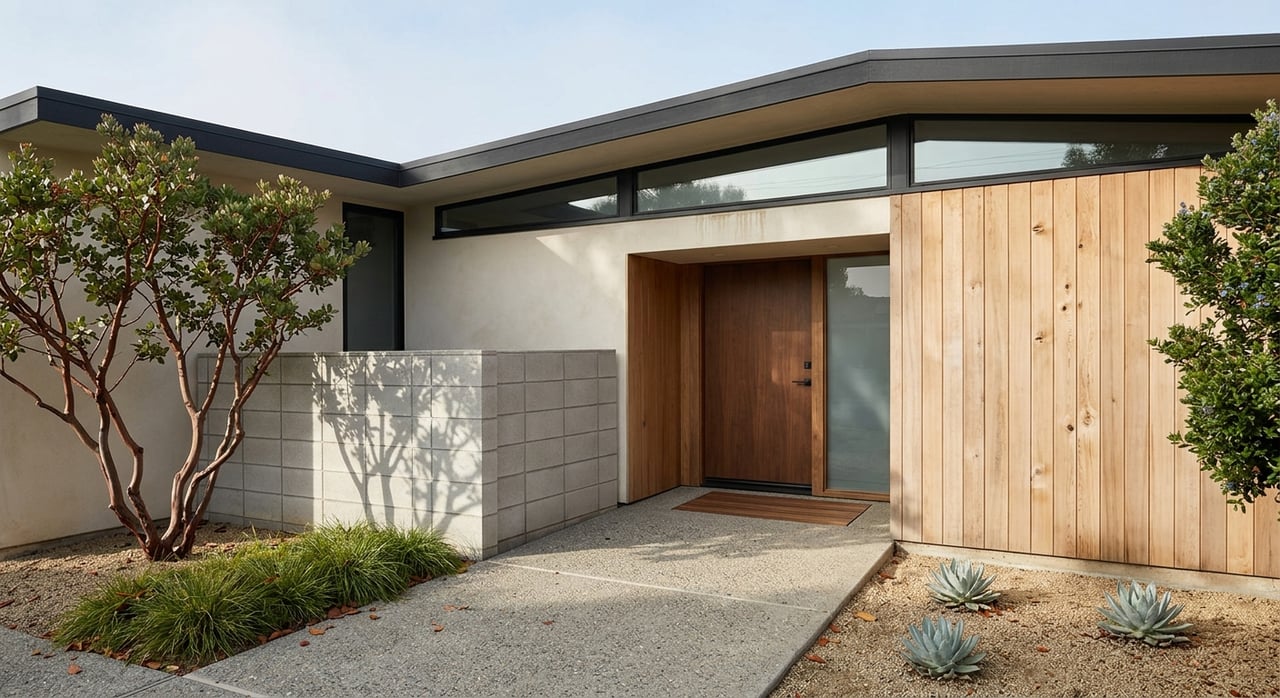
Mid-century modern homes represent a later chapter in Monterey’s housing story. National Park Service material describes the style as part of a postwar movement built from the mid-1940s through the 1970s, with clean lines, simple shapes, minimal ornament, modern materials, and strong indoor-outdoor connections.
You may also see flat roofs, ribbons of windows, terraces, cantilevers, and post-and-beam construction. Compared with many older Monterey homes, these properties often feel visually lighter and more open.
For buyers, the appeal is usually easy to understand. These homes can offer brighter interiors, broader sight lines, and a stronger emphasis on views.
In Monterey, it helps to think of mid-century homes as part of the city’s postwar coastal layer rather than its oldest architectural identity. They can be a great fit if you want openness and simplicity while still living within Monterey’s broader historic setting.
Condos, Townhomes, And Attached Homes
Not every Monterey buyer is looking for a detached historic house. Condos, townhomes, and other attached homes are part of the city’s more recent residential evolution.
That makes sense in a market with a meaningful rental presence and later multi-family development in places like Lower Old Town. While attached housing is not a historic style in the same way as Monterey Colonial or Craftsman, it is an important part of the current housing conversation.
These homes often trade private yard space for lower exterior maintenance, smaller footprints, and easier lock-and-leave living. If you want a simpler day-to-day setup or spend time away from the Peninsula, that tradeoff may be worth serious consideration.
For sellers, it is helpful to understand that buyers often compare attached homes less on architectural pedigree and more on layout, condition, outdoor space, storage, and maintenance demands.
How Monterey’s Climate Changes The Equation
Monterey’s marine setting affects how a home feels almost every day. NOAA notes that the West Coast marine layer can linger for days or even weeks, bringing low clouds or fog near the surface.
A Monterey Bay environmental document also notes that marine breezes dominate the local climate, with westerly winds strongest and most persistent in spring and summer. In practical terms, buyers often pay close attention to how a home handles fog, wind, filtered light, and coastal moisture.
That is one reason covered porches, verandas, patios, balconies, and larger windows stand out in this market. They can make outdoor space more usable even when the weather is cool or gray.
When you tour homes in Monterey, it helps to look past the listing photos and ask simple questions. How bright does the home feel in the morning? Where does the wind hit hardest? Which outdoor spaces are truly usable most of the year?
Coastal Maintenance To Watch Closely
In Monterey, maintenance is not a side issue. It is part of ownership planning.
FEMA notes that salt spray and onshore winds can significantly accelerate corrosion of metal connectors in coastal areas, with the greatest salt exposure near breaking waves and a rapid decline farther inland. For a buyer, that means exterior metals deserve careful attention.
Look closely at balcony hardware, railings, fasteners, roof edges, window and door trim, and other exposed metal components. Even in a beautiful home, deferred exterior maintenance can become expensive if coastal wear has been ignored.
For sellers, this is where thoughtful preparation matters. Addressing visible maintenance items before listing can help reduce buyer concern and support a cleaner negotiation process.
Historic Rules And Renovation Planning
If you are considering an older Monterey home, renovation freedom may not be the same as it would be in a typical suburban neighborhood. The city’s Old Town design guidelines explain that Monterey uses a Historic Preservation Ordinance, H-1 Landmark Overlay Zoning, H-2 City Historic Resource Overlay Zoning, and review guidelines for alterations, additions, and new construction in historic areas.
The same document notes that the Historic Preservation Commission acts on matters affecting historic resources. In plain terms, exterior changes on certain older homes may involve additional review.
That is not necessarily a negative. Preservation rules can help protect the character that makes these homes valuable and distinct.
But if you are a buyer with major design plans, it is wise to understand the review framework early. If you are a seller, it helps to be clear about what work has been done and what approvals may have applied.
A Simple Way To Match Style To Lifestyle
The best Monterey home style for you depends on how you want to live, not just what looks good in photos. A historic Monterey Colonial may appeal to you if you value architectural identity and covered outdoor space. A Craftsman bungalow may fit if you want charm and a more compact layout.
A Spanish-influenced home may suit you if you like patios, thick walls, and a sheltered feel. A mid-century home may be a better match if you want openness, glass, and a stronger connection to views.
And if lower-maintenance living is the priority, a condo or townhome may offer the best balance of convenience and cost control. In Monterey, every style comes with a practical side, and understanding that early can save you time, stress, and expensive surprises.
If you want help sorting through those tradeoffs, it pays to work with someone who understands both the architecture and the real-life decisions behind it.
Whether you are buying a coastal condo, selling a historic property, or trying to decide which Monterey home style fits your next chapter, Mark Cohan can help you move forward with calm, informed guidance.
FAQs
What is Monterey Colonial style in Monterey?
- Monterey Colonial is a historic local style known for two-story forms, thick adobe walls, hipped roofs, wood windows, and long covered upper porches or verandas.
What home styles are common in Monterey, California?
- Monterey includes a mix of Monterey Colonial, Craftsman Bungalows, vernacular cottages, Spanish Colonial, Mission-influenced homes, mid-century modern homes, and newer attached housing such as condos and townhomes.
Why does climate matter when buying a Monterey coastal home?
- Monterey’s marine layer, fog, westerly winds, and coastal moisture can affect light, outdoor usability, and long-term maintenance.
What maintenance issues should buyers watch in Monterey homes?
- Buyers should pay close attention to exposed metal components, balcony hardware, railings, fasteners, roof edges, and exterior trim because salt air can accelerate corrosion.
Are historic Monterey homes harder to renovate?
- Some older Monterey homes may be subject to historic preservation rules and review guidelines, especially for exterior changes in designated historic areas.
Are condos and townhomes common in Monterey?
- Yes. Attached housing is part of Monterey’s more recent residential evolution and can appeal to buyers who want lower exterior maintenance and easier lock-and-leave living.
