If you picture Monterey as a place you only visit for a weekend, you might miss what makes it appealing for everyday life. This is a small coastal city where the shoreline, historic core, and daily errands can sit surprisingly close together. If you are thinking about a move, it helps to understand not just the scenery, but how Monterey actually functions day to day. Let’s dive in.
Monterey Feels Compact and Connected
Monterey is relatively compact by California coastal standards, with 29,015 residents across 8.65 square miles of land area. Census data also shows a mean travel time to work of 18.6 minutes, which helps explain why the city often feels more connected than spread out.
For you, that can mean less time crossing town and more time getting familiar with a few central places. Daily life often revolves around downtown, Cannery Row, Old Fisherman’s Wharf, the aquarium area, and the coastal trail rather than long drives between distant districts.
That compact layout is part of Monterey’s appeal. It can feel approachable if you want a coastal setting with activity nearby, but without the scale of a much larger metro area.
Coastal Access Is Part of Daily Life
In Monterey, the waterfront is not just a backdrop. City planning documents describe the Monterey Bay Coastal Recreation Trail as a major pedestrian and bicycle corridor, running along the former Southern Pacific rail right-of-way.
That matters because it shapes how people actually use the city. Beach and shoreline activities described in city materials include kayaking, swimming, strolling, jogging, fishing, windsurfing, multi-hull sailing, and skin diving.
In practical terms, Monterey can support a lifestyle where outdoor time fits naturally into your week. A walk along the coast, a bike ride through the waterfront corridor, or a quick stop by the bay can feel less like a special outing and more like part of your routine.
Waterfront Activity Comes With Tradeoffs
The same features that make Monterey attractive also bring more visitor activity to the core. Official tourism and land-use sources identify Old Fisherman’s Wharf, Cannery Row, and the Monterey Bay Aquarium as some of the city’s best-known anchors, and city planning materials note that visitor-serving commercial uses are concentrated in downtown, the harbor, and Cannery Row.
If you are considering living in Monterey, this is an important everyday detail. Parking and traffic tend to be more of a factor in those popular areas than on quieter residential streets.
That does not mean the city feels overwhelmed everywhere. It means your day-to-day experience can vary depending on where you live and how often your routines take you through the waterfront core.
Historic Character Shapes the City
Monterey’s history is easy to see in the built environment. The city’s Path of History materials document 55 historic sites along a two-mile route, which gives you a sense of how visible the past remains in everyday life.
Downtown planning also supports a pedestrian-friendly, mixed-use pattern in some areas, with retail at street level and housing above. Along Alvarado Street, official tourism content describes a mix of restaurants, wine tasting rooms, craft breweries, and shops.
This combination gives Monterey a layered feel. You are not looking at a city built around one housing style or one type of commercial corridor. Instead, historic buildings, walkable blocks, housing, and visitor-focused destinations often sit close together.
Housing Types Vary More Than Many Buyers Expect
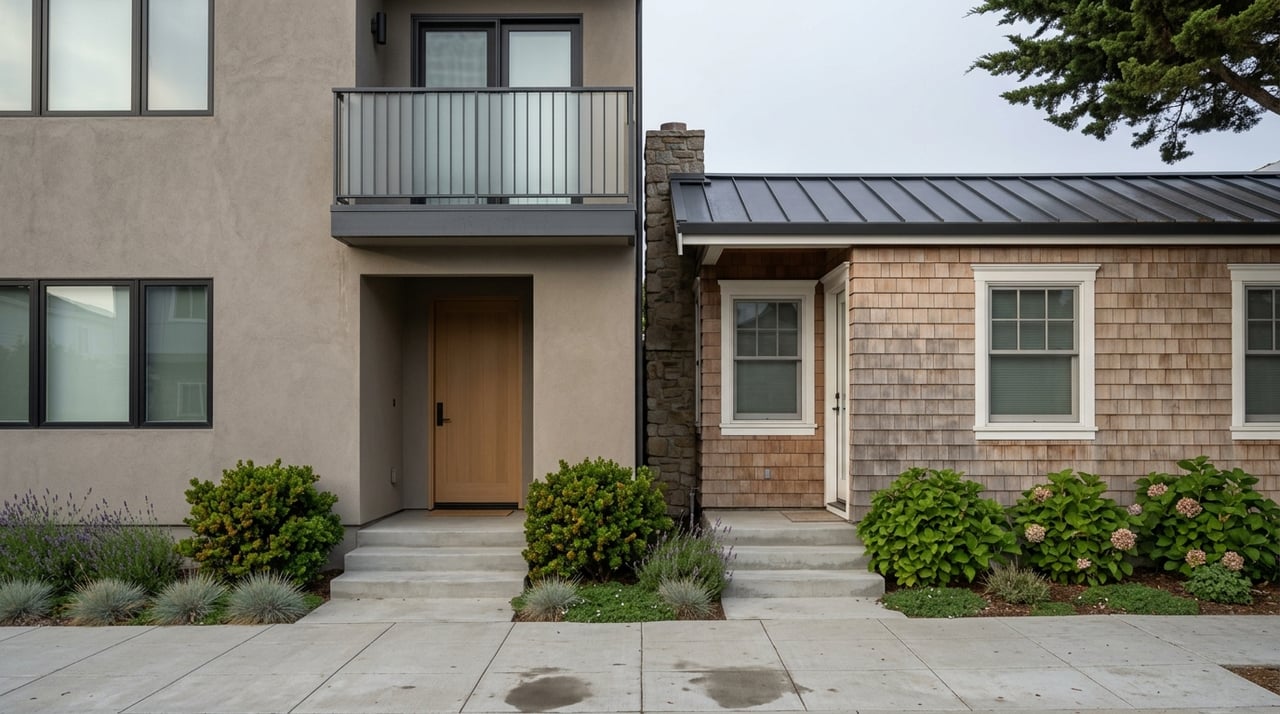
Monterey’s housing mix is one of the more important things to understand before you move. City planning documents reference apartment and condominium housing near downtown, townhouse development in the waterfront area, and single-family residential buildings within the historic district.
That variety can be helpful if you are trying to match your home choice to your lifestyle. A condo or co-op may offer a different price point and maintenance profile than a detached home, while a townhome can sit somewhere in between depending on location and features.
Census data adds useful context. Monterey has an owner-occupied housing rate of 37.9%, a median owner-occupied value of $1,003,300, and a median gross rent of $2,288.
Monterey Home Prices Require Careful Comparison
Monterey price data is best read as a range, not a single number. One market snapshot showed an average home value of $1,189,607 and a median list price of $1,046,500 as of April 30, 2026, while another source reported a March 2026 median sale price of $875,000 overall.
Breaking that down further, the same sales snapshot showed a median of $483,000 for condo and co-op properties, $1,075,000 for single-family homes, and $1,420,000 for townhouses. Because these figures come from different services and use different methods, they are most useful as directional context.
For you, the takeaway is simple: Monterey has real price variation. Entry points can look different depending on whether you focus on condos, townhomes, or single-family homes, and location within the city can also influence where a property falls in the range.
Getting Around Monterey
Monterey is not built like a sprawling commute-heavy city, but it does have practical transportation options. Monterey-Salinas Transit includes service connecting Monterey with Pacific Grove, Carmel, and Salinas, which supports local and regional movement without relying on a car for every trip.
For shorter trips in the city’s core, the free MST Monterey Trolley is especially useful. MST says the trolley runs daily during the summer season and on weekends in the off-season, serving downtown Monterey, Fisherman’s Wharf, Cannery Row, and the Monterey Bay Aquarium.
That kind of service can make it easier to navigate popular visitor areas, especially when parking is tight. It is one more example of how Monterey’s compact size supports a more connected daily rhythm.
Regional Access Is Better Than Some Expect
Smaller coastal cities can sometimes feel isolated, but Monterey has practical regional access. Monterey Regional Airport advertises more than 40 flights in and out daily, which helps keep the city connected even while it remains shoreline-oriented and relatively compact.
If you travel for work, host out-of-town family, or split time between markets, that convenience can matter. It does not make Monterey a major urban hub, but it can make day-to-day logistics easier than some buyers assume.
What Everyday Living Often Means in Monterey
A realistic picture of Monterey includes both convenience and complexity. You get strong walkability in the core, easy access to the waterfront, visible historic character, and a city layout that can feel manageable.
At the same time, everyday life here includes seasonality, visitor traffic in key areas, parking considerations, and a housing market where affordability deserves careful planning. Those are not drawbacks for every buyer, but they are part of the decision.
If you are considering Monterey, the question is less about whether it is beautiful and more about whether its rhythm fits the way you want to live. For many people, that mix of coastal access, character, and convenience is exactly the point.
Whether you are comparing neighborhoods, weighing housing types, or trying to understand how Monterey fits your long-term plans, a calm local strategy helps. If you want grounded guidance on the Monterey Peninsula market, reach out to Mark Cohan for a conversation tailored to your goals.
FAQs
What is everyday life like in Monterey, California?
- Everyday life in Monterey often centers on a compact coastal core with access to downtown, Cannery Row, Old Fisherman’s Wharf, and the Monterey Bay Coastal Recreation Trail, with shorter cross-town travel than in many larger coastal cities.
Is Monterey, California, a walkable city?
- Monterey offers strong walkability in its core, especially around downtown and the waterfront, and city planning documents describe the coastal recreation trail as a major pedestrian and bicycle corridor.
What kinds of homes are available in Monterey?
- Monterey includes a mix of housing types, including apartments, condominiums, townhouses, and single-family homes, rather than a single dominant housing pattern.
How expensive is housing in Monterey, California?
- Housing costs in Monterey vary by property type and data source, with recent snapshots showing lower median pricing for condo and co-op properties than for single-family homes and townhouses.
Does Monterey have public transit options?
- Yes. Monterey-Salinas Transit provides routes connecting Monterey with nearby areas like Pacific Grove, Carmel, and Salinas, and the free Monterey Trolley serves key destinations in the city’s core during seasonal periods.
Is traffic a concern in Monterey?
- Traffic and parking are more noticeable around high-visitor areas such as downtown, the harbor, Cannery Row, and Old Fisherman’s Wharf than on quieter residential streets.
Is Monterey a good fit for buyers seeking coastal living?
- Monterey can be a strong fit if you want coastal access, historic character, and a compact city layout, but it is important to weigh visitor activity, parking, and housing costs as part of your decision-making process.
